Welcome to IberSPEECH 2026, held in Madrid on November 18–20, 2026, and organized by the Universidad Politécnica de Madrid (UPM), through the Escuela Técnica Superior de Ingenieros de Telecomunicación (ETSIT) and the Grupo de Tecnología del Habla y Aprendizaje Automático (GTHAU). The conference has received inestimable support from the Spanish Thematic Network on Speech Technology (RTTH), the International Speech Communication Association (ISCA) and its Special Interest Group on Iberian Languages (SIG-IL), and RISE (Refuerzo e Impulso de los servicios de la UPM y de sus Comunidades Temáticas como Entidades de Enlace), as well as from our sponsors Euskorpora (Platinum), Cires21, BTS, Orai NLP Teknologiak and Vicomtech (Gold), and Sigma Cognition (Silver).
IberSPEECH 2026 – the eighth event using this name – brings together the XIV Jornadas en Tecnologías del Habla and the X Iberian SLTech Workshop. Both events pursue the aim of being a meeting point to present and discuss the results of research on speech and language technologies for Iberian (and other) languages, and of promoting industry/university collaboration.
The IberSPEECH series has its roots in two long-standing initiatives: the Jornadas en Tecnologías del Habla, promoted by the Spanish Thematic Network on Speech Technology (RTTH) since 2000 and held in Seville (2000), Granada (2002), Valencia (2004), Zaragoza (2006) and Bilbao (2008), and the Iberian SLTech Workshop, created in 2009. Both events first joined efforts at FALA 2010 in Vigo and, since 2012, have been held together under the IberSPEECH name in Madrid (2012), Las Palmas de Gran Canaria (2014), Lisbon (2016), Barcelona (2018), Valladolid (2021), Granada (2022) and Aveiro (2024). IberSPEECH 2026 therefore marks a return to Madrid, which hosted the first edition under this name fourteen years ago. Today, the conference is one of the main activities of the ISCA Special Interest Group on Iberian Languages (SIG-IL) and of the RTTH, and has become the reference forum for the community working on speech and language technologies for Iberian languages in Spain, Portugal, Latin America and beyond.
The venue, the Escuela Técnica Superior de Ingenieros de Telecomunicación (ETSIT-UPM), is located in Madrid’s Ciudad Universitaria area, at Avenida Complutense 30. Founded in 1957, it is considered one of Europe’s most prestigious telecommunications engineering schools and combines a long tradition of academic excellence with a strong orientation toward research, innovation and technology transfer. The campus is easily reached by Metro line 6 (Ciudad Universitaria and Metropolitano stations) and by several city bus lines, and lies about 20 km from Adolfo Suárez Madrid–Barajas Airport.
Beyond the conference sessions, we hope that participants will take the opportunity to enjoy Madrid, a city that never sleeps, a vibrant capital renowned for its world-class museums, such as the Prado, the Reina Sofía and the Thyssen-Bornemisza, its remodelled Bernabeu stadium, its five towers area featuring the four tallest towers of Spain, its urban tunnel (the longest in Spain), its historic city centre and its lively cultural and culinary life.
Following the tradition of previous editions, IberSPEECH 2026 is a three-day event that gathers researchers and practitioners in speech and language technologies to promote interaction and discussion. The organizing committee has planned a wide variety of activities, including technical paper presentations, keynote lectures, special sessions for the presentation of projects, demos, recent PhD theses and entrepreneurship experiences, a session dedicated to the Albayzin Evaluation Challenge, and an industrial innovation round table.
Reflecting this year's slogan, “Where Speech Meets Intelligence”, the programme showcases the convergence of speech technologies and artificial intelligence. In addition to contributions exploring new AI-driven approaches, the accepted papers cover a broad range of topics across speech technologies, including speech synthesis and recognition, speaker verification, spoofing detection, clinical applications and speech pathologies, multimodality, sign language, among others.
The core of the scientific program includes 56 regular papers distributed among 6 oral sessions (30 papers) and 2 poster sessions (26 papers). To ensure the quality of all contributions, each submitted paper was reviewed by three members of the scientific committee and handled by a meta-reviewer. The selection of the papers was based on the scores and comments provided by the committee, which includes more than 70 researchers from different institutions, mainly from Spain and Portugal, but also from other European countries and beyond. All accepted papers are included in the conference proceedings published in the ISCA Archive.
In addition to the regular sessions, the program features a Special Poster Session on Innovation and Commercialization with 10 contributions describing ongoing projects, demonstration systems, recent PhD theses and entrepreneurship experiences. The Albayzin Evaluation Challenge 2026, “ALBAYZIN 2026 Speech Technologies for COSER: A Spanish Rural Corpus (Speech-COSER)”, was organized by Universidad CEU San Pablo and AUDIAS (Universidad Autónoma de Madrid) with the support of the RTTH. It comprised three tasks – automatic speech recognition, speaker diarization and spoken term detection – based on COSER, the largest corpus of dialectal European Spanish. Finally, thirteen system description papers (three of which are included in the proceedings) will be presented during the Albayzin Challenge poster session.
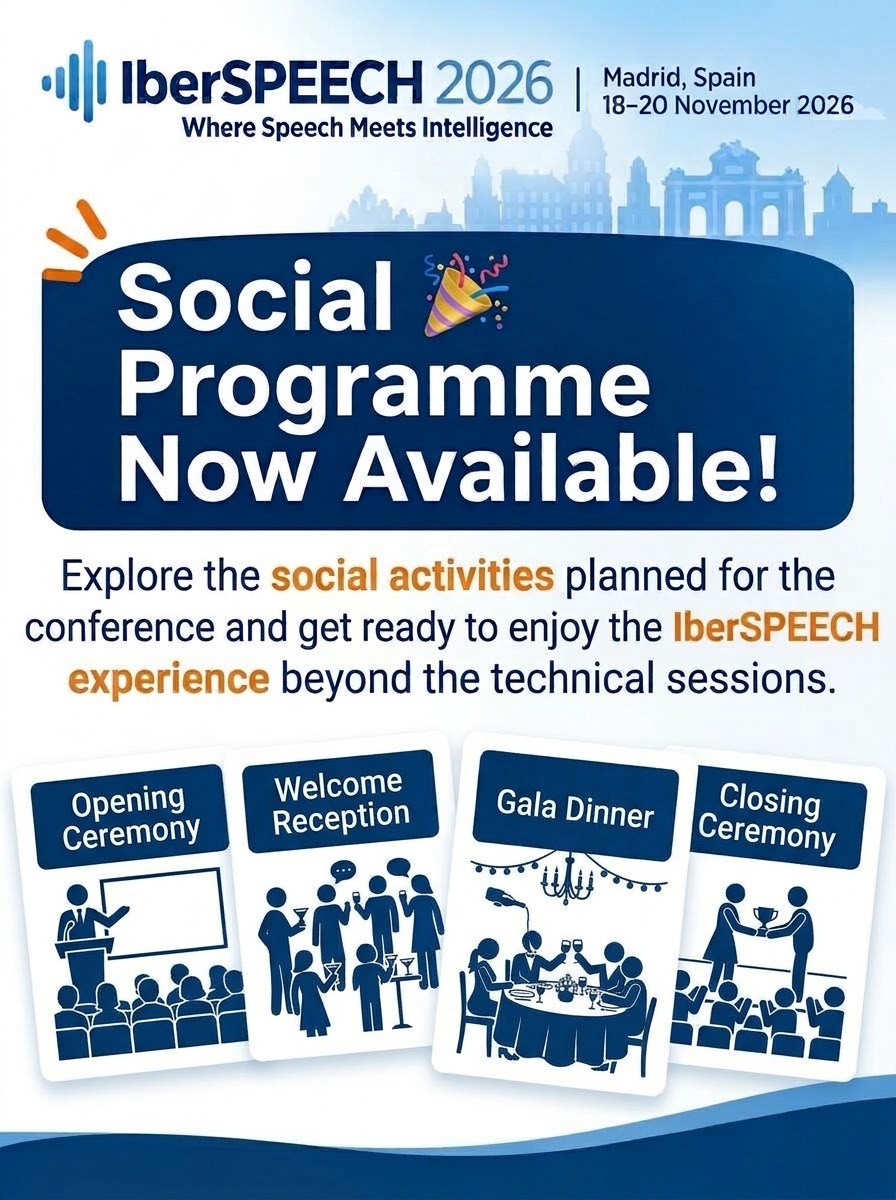
IberSPEECH 2026 also features two remarkable keynote speakers: Prof. Elisabeth André (Augsburg University, Germany) and Prof. João Magalhães (Universidade NOVA de Lisboa, Portugal), to whom we would like to express our gratitude for their extremely valuable participation. The technical program closes with an Industrial Innovation Round Table on “Speech and Language Technologies in the Age of AI”. The social programme includes a welcome reception at ETSIT on Wednesday and the gala dinner on Thursday at Teitu, a traditional Asturian cider house.
As in previous editions, IberSPEECH 2026 will recognise outstanding contributions through several awards: the Best Paper Award, for regular papers whose first author is a student; the Best PhD Thesis Award; and awards for the best systems submitted to the Albayzin Challenge, these awards continue a tradition dating back to 2006. The winners will be announced at the closing ceremony. We are especially pleased by the participation of so many young researchers, whose work is a clear sign of the vitality of our community.
Finally, we would like to thank all those whose effort made this conference possible, including the members of the Local Committee, the Technical Program Committee, the Challenges Committee, the Scientific Committee, as well as the authors, the conference attendees, the supporting institutions and companies, and so many people who gave their best to achieve a successful conference.