
VENUE
Institutional Description
The Universidad Politécnica de Madrid (UPM) is Spain’s leading technological university (QS World University Rankings by Subject 2025), committed to excellence in education, cutting-edge research, innovation transfer, and strong engagement with industry. Established in 1971 through the integration of several historic engineering schools—some founded in the 19th century—UPM combines long-standing academic tradition with modern scientific and technological development.
With a student population of over 35,000 and more than 40 schools, faculties, and research institutes, UPM offers a comprehensive set of undergraduate, master’s, and doctoral programs across engineering, architecture, science, and technology. Its academic activity is supported by a vibrant community of researchers, including multiple national and international research centers and laboratories of excellence.
UPM’s mission is to generate, communicate, and apply knowledge in science and engineering by fostering high-quality teaching, multidisciplinary research, and collaboration with society. The university maintains strong partnerships with major industrial sectors, public institutions, and international networks, promoting innovation and contributing to the economic and technological development of Spain and Europe.
UPM follows an organizational model based on specialization and interdisciplinary cooperation among its schools, research centers, and technology transfer units. Its strategic priorities include sustainability, digital transformation, entrepreneurship, and internationalization, reinforcing the university’s position as a key actor in the global scientific community.
GOLD SPONSOR

Escuela Técnica Superior de Ingenieros de Telecomunicación (ETSIT-UPM)
The Escuela Técnica Superior de Ingenieros de Telecomunicación (ETSIT) of the Universidad Politécnica de Madrid is one of Europe’s most prestigious institutions in the field of telecommunications engineering. Founded in 1957, ETSIT combines decades of academic excellence with a strong orientation toward research, innovation, and technological development.
The school hosts a diverse community of undergraduate, master’s, and doctoral students enrolled in programs covering telecommunications engineering, sound and image engineering, electronics, data science, and related technological fields. Its curriculum is designed to integrate solid scientific foundations with practical engineering training, providing students with the skills needed to contribute to rapidly evolving digital and communication technologies.
ETSIT is strongly research-oriented, with numerous specialized laboratories, research groups, and R&D units participating in national and international projects. The school maintains long-standing collaborations with key industry partners, research institutions, and global technology companies, reinforcing its leadership role in areas such as wireless communications, signal processing, artificial intelligence, cybersecurity, photonics, and multimedia systems.
Its mission focuses on fostering educational excellence, advancing scientific knowledge, and promoting innovation and technology transfer to society, while offering a dynamic environment that encourages interdisciplinary collaboration and entrepreneurship.
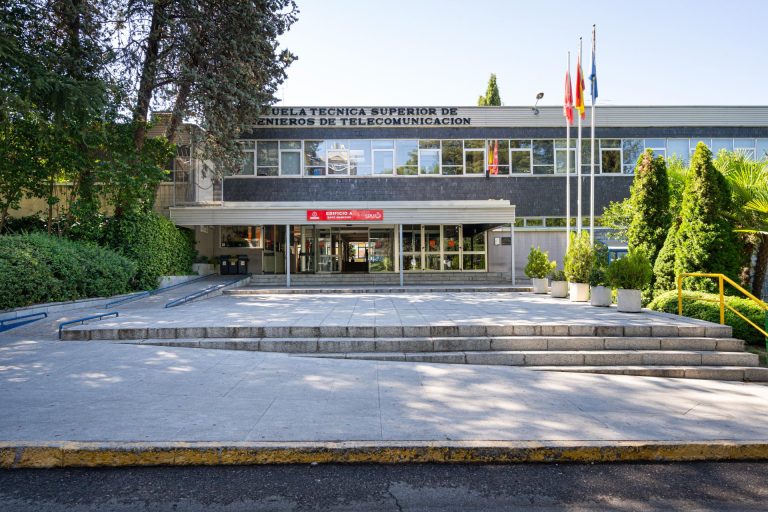

Location and Access
ETSIT is located in the Ciudad Universitaria area of Madrid, within the main university district of the Spanish capital. The school’s address is Avenida Complutense 30, 28040, Madrid, situated next to the A-6 motorway corridor and surrounded by other higher-education and research institutions.
The area is easily accessible by public transport. Metro line 6 (stations “Ciudad Universitaria” and “Metropolitano”) provides direct connections to the rest of the city. Multiple EMT bus lines link the campus with central Madrid and adjacent neighborhoods. Cycling paths and shared mobility options are also available throughout the university district.
Madrid’s Adolfo Suárez Madrid–Barajas International Airport lies approximately 20 km away, offering extensive national and international connections. Long-distance train services (including high-speed AVE links) arrive at the major rail stations of Atocha and Chamartín, both of which are well connected to Ciudad Universitaria via metro and bus.
Additional information on how to reach ETSIT can be found at:
https://www.etsit.upm.es/